Design of flow battery active material for Redox Flow Batteries (Dr. Patric Cappillino)
 Redox Flow Batteries are a promising next-generation rechargeable energy storage technology in which energy is stored in liquid form. These liquids are pumped through a cell during charging and discharging, allowing energy storage capacity to be scaled up just by using larger tanks. This makes them especially useful for supporting renewable energy and stabilizing the power grid.
Students will undertake an independent project to synthesize and characterize active materials developed in our lab using techniques of chemical synthesis along with characterization using and infrared, electronic and NMR spectroscopy as well as X-Ray Diffraction techniques and electrochemical methods. Students would then implement modified synthetic protocols to generate new active materials with improved properties. In cooperation with senior graduate students, these active materials will then be electrochemically characterized using cyclic voltammetry and bulk electrolysis.
Experimental tools: Infrared Spectroscopy; UV-vis spectroscopy; X-Ray Diffraction; Electrochemistry.
Data analysis tools: Microsoft Excel, Adobe Photoshop, Matlab
Cost-effective Elastic Filament Velocimetry (EFV) Sensor for Small Unmanned Underwater Vehicles (UUVs) (Prof. Kihan Park)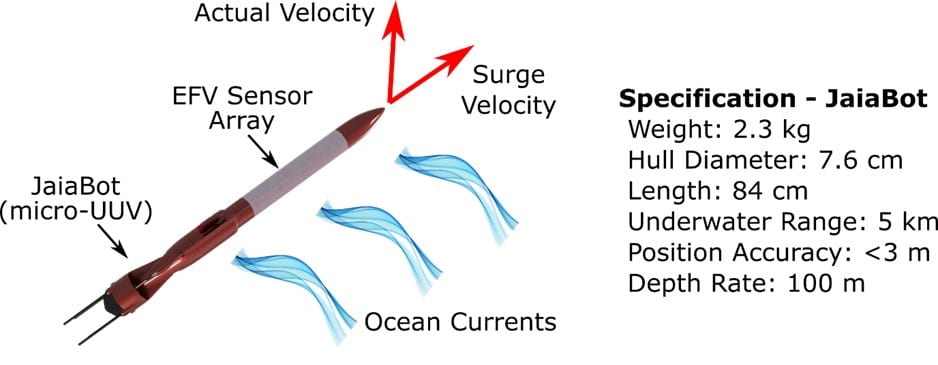
The project aims to develop a cost-effective, lightweight, drift-free, self-contained, standalone sensor network using elastic filament velocimetry (EFV) for real-time identification of velocity and pose of small unmanned underwater vehicles (UUVs) in 3-dimensional space. Accurate real-time velocity measurement of UUVs is an essential capability for successful undersea navigation, especially when without the help of a global positioning system (GPS). We will fabricate the submersible sensor in MIT’s Fab.nano facility and an REU student is expected to take an independent role in this project regarding one of the following tasks: design / fabricate / characterize / testing the sensor in various fluidic environments.
Experimental tools: JaiaBot (small unmanned underwater vehicle), custom-built sensors, Data Acquisition Boards (DAQs), and Microcontrollers.
Data analysis tools: SolidWorks, Arduino IDE, Python, and Matlab.
Antifouling on nanostructured surfaces (Dr. Wei-Shun Chang)

In this REU project, he proposes to fabricate composite materials with plasmonic nanoparticles and integrate them into electro-optical devices for optical camouflage. Optical camouflage has been widely deployed in the military to reduce the visibility of weapons and soldiers to potential threats. The currently deployed technologies rely on the passive camouflage technique, which adapts the color and texture of the combat units to the known environment. However, the passive camouflage is not functional when the local background changes.
The REU student participants will design and fabricate composite materials with plasmonic nanoparticles to show different colors and characterize their spectra using the microscopic method developed in the Chang Lab.
Experimental tools: Hot plate, UV-VIS, CD spectrometer, custom-fabricated liquid crystal display, function generator, polarizer analyzer
Data analysis tools: Matlab
Novel bi-functional composite materials for structural energy storage in marine systems (Dr. Caiwei Shen)
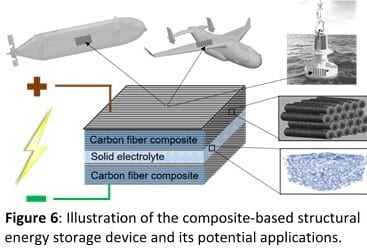 An increasing number of electrically powered marine systems such as distributed sensors and autonomous underwater vehicles (AUVs) are being deployed in the oceans. The operation time, useful lifetime, and the overall size of such systems are still limited by the energy storage components (e.g. rechargeable batteries) that provide the power. Meanwhile, polymer matrix composite (PMC) materials are widely used as structural components in all kinds of naval systems partly due to their outstanding mechanical properties, lightweight and durability. Here we aim to develop novel bi-functional composites (shown in Figure) that integrate energy storage functionality into structural PMC for maritime applications.
REU students will work on an independent project in Shen’s lab to fabricate multi-functional composites and perform (a) elemental and microstructural analysis of materials, (b) mechanical testing of materials, (c) electrochemical tests of energy storage devices, and (d) explore their applications in marine systems.
Experimental tools:
For Sample Preparation: Injection molding machine; Hot-rolling machine; Glove box; Electronic balances; Ovens and furnaces.
For Materials Characterization:DSC (Differential Scanning Calorimeter); FTIR (Fourier Transform Infrared Spectroscopy); XRD (X-ray Diffraction); AFM (Atomic Force Microscope); SEM (Scanning Electron Microscope); Material testing system; Potentiostat; Multimeter.
Data analysis tools: Microsoft Excel
Simulation and Modeling of Corrosion Mechanism and Inhibition in Marine Environments (Prof. Maricris Mayes)

Corrosion, the electrochemical degradation of metals, remains a critical challenge in marine and industrial environments where high salinity, variable temperature, and microbial activity accelerate material failure. This project focuses on microbiologically influenced corrosion (MIC), in which microbial communities alter local chemistry, creating acidic, sulfide-rich, or redox-active microenvironments that intensify corrosion and compromise metal durability. The goal of this project is to understand how microbial metabolites interact with metal surfaces at the atomic level and to explore how molecular inhibitors can disrupt these processes to protect materials from degradation. REU students will conduct hands-on computational chemistry research, using advanced approaches such as quantum chemical calculations, molecular dynamics, and molecular docking to model materials and chemical interactions. The students will gain experience in molecular simulation, materials design, and corrosion science, and discover how computational chemistry can help build more sustainable and corrosion-resistant technologies.
Ultra-Stable Super-Hydrophobic Surfaces for Next-generation Marine Vessels (Prof. Hangjian Ling)

Have you ever imagined what the next generation of environmentally friendly, energy-efficient marine vessels might look like? One promising solution is to coat vessel surfaces with a bioinspired superhydrophobic surface (SHS). Recent studies have shown that SHS can significantly reduce hydrodynamic friction by trapping a thin layer of lubricating air between the moving vessel and the surrounding water. This reduction in drag can lead to substantial savings in fuel and energy consumption, as well as improvements in vessel speed and range.
However, applying SHS to real-world marine vessels remains challenging. One of the primary issues is the stability of the air layer in high-speed turbulent flows, where it tends to become disturbed and unstable. This project seeks to address that challenge by fabricating ultra-stable SHS using high-precision laser texturing techniques. A variety of micro- and nanoscale surface textures will be designed, manufactured, and tested. The performance of these fabricated samples will be evaluated through high-speed imaging and advanced experimental measurements.
Experimental tools: Laser texturing, High-speed camera, Scanning Electron Microscopy, Contact angle measurement
Data analysis tools: Matlab, Image Processing
Damage sensing studies in intra-ply laminate composites under fatigue loading (Prof. Vijay Chalivendra)

Outstanding properties of fiber reinforced polymer composite materials, lead to wide range of applications in all the sectors such as aerospace, automotive, marine, sports industries and even in the civil infrastructures, etc. Especially, their use in unmanned underwater vehicles (UUV) needs them to withstand hydro-static pressures and cold temperatures. Having the detection of damage evolution in these composites under these conditions will help for their structural health monitoring. In this study, we will simulate the application of hydro-static pressure (by subjecting bi-axial loading) and cold water temperature conditions (shown in Figure) on intra-ply hybrid carbon/glass epoxy composites, Later, we investigate damage sensing characteristics of the composites (that are subjected to bi-axial loading and cold water temperature conditions) under fatigue loading conditions using novel four-circumferential probe technique. The piezo-resistance change due to damage evolution in these composites under fatigue loads will be connected with scanning electron microscopy images of fracture surfaces.
Experimental tools: vacuum infusion process for fabricating composites, fatigue testing system, constant current source, electrometers, digital multimeter, LabView.
Data analysis tools: Excel, Matlab
Microbial valorization of lobster shell chitin (Dr. Brigham and Dr. Ferreira)

Chitin is one of the most abundant polysaccharides on earth. Large amounts of chitin are disposed of every year due to the cultivation of lobster, crabs, and shrimp for human consumption [171]. Drs. Brigham and Ferreira have been working on developing a microbial system to isolate chitin from lobster shells and break it down into its component monosaccharide, N-acetyl-D-glucosamine (glcNAc). The N-acetyl-D-glucosamine amino sugars can be used to grow industrially relevant microorganisms with the goal of producing value-added compounds like biofuels.
REU participant will be developing culture conditions to maximize polyhydroxyalkanoate (PHA) bioplastic production using glcNAc as the main carbon source to be performed during the 10-week period. In Ralstonia eutropha cultures, PHA synthesis is usually maximized by altering the ratio of carbon to nitrogen. A high carbon-to-nitrogen ratio (C/N) is required to produce significant amounts of intracellular polymer. With nitrogen being present in glcNAc, culture conditions must be optimized to provide enough carbon to synthesize PHA and enough nitrogen to maintain a viable culture. Other nutrient sources may be limited to promote PHA formation.
Experimental tools: Microbial culture and physiology, including growth curves and colony formation; culture media chemistry; high-pressure liquid chromatography (HPLC); chemical testing of nutrient concentrations using specific assays; assay design; polymerase chain reaction (PCR); agarose gel electrophoresis
Data analysis tools: Microsoft Excel: graphing and simple statistics; DNA sequence analysis using SnapGene; gel electrophoresis of DNA molecules (visualization of fluorescence)